

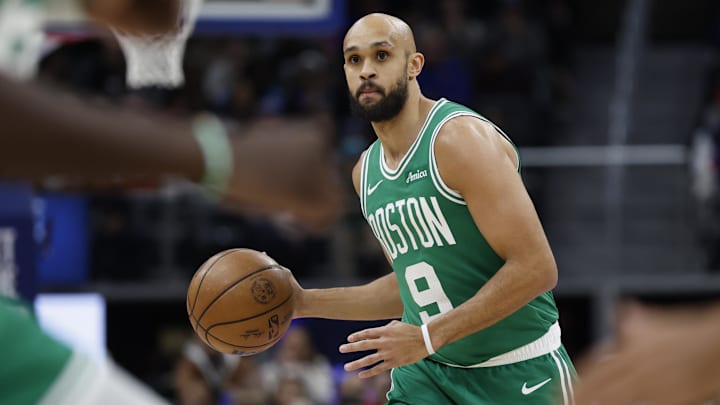
Derrick White is an icon in Boston. Celtics fans grew enamored with him for his defensive playmaking, knack for hitting big shots, and willingness to put his body on the line.
But for as much goodwill as he’s built with the Boston faithful, there’s growing concern about his major regression in efficiency through the first half of the 2025-26 season. As of Jan. 24, White is averaging a career-high 17.6 points per game. However, he’s doing so while shooting a career-worst 39.1% from the field.
White is in the first season of his four-year, $118M contract. At 31 years old, the Celtics must determine whether his shooting slump is a sign of an oncoming decline or simply circumstantial.
The team experienced a roster overhaul in the summer. Every player matters now more than ever. If the organization is going to evaluate White’s long-term place in its core, it can’t be overly reactionary to this season. Context matters — and this season has presented a radically different environment than any White has experienced in Boston.
A closer look at the numbers suggests those surrounding circumstances are the most likely culprit, and that when Jayson Tatum returns, White should be primed for a bounce-back.
Life as the No. 2 Option
Including Tatum’s injury absence, the Celtics lost 48.2% of their point production from their 2024-25 campaign. Maintaining the elite offense built under head coach Joe Mazzulla was going to be an uphill battle, yet Boston has risen to the challenge.
Through 44 games, the Celtics boast a 121.2 offensive rating — best in the NBA. That success has required increased responsibility across the roster, and White has been at the center of it.
He has effectively become Boston’s No. 2 offensive option. He ranks second on the team in points per game, assists per game, and usage rate — a combination that underscores the nightly burden he’s shouldering.
As his production has increased, however, his efficiency has moved sharply in the opposite direction. Some dip in field-goal percentage was inevitable with the role change, but a drop of more than five percent is a steep decline.
White’s Ascendence is Rooted in Shooting
When the Celtics acquired White ahead of the 2022 trade deadline, president of basketball operations Brad Stevens called White a “perfect fit for our best players” (h/t Tim Bontemps, ESPN), citing his defense and decision-making.
White showed flashes of that fit immediately, but the 2022 Finals exposed his limitations as a shooter. After a strong two-way performance in Game 1, he struggled over the final five games as Boston dropped the series. He shot 7-for-27 from deep while the Celtics were outscored by 87 points in his minutes.
Despite those struggles, the front office saw enough to fully commit to White as a starter. They traded Marcus Smart, who was the longest-tenured Celtic, to make room for him. As his defensive potential came to fruition — resulting in All-Defensive Second Team honors — a shooting leap came with it. His three-point percentage jumped to 38.1%.
White’s efficiency never looked back — until this season. Through 42 games, he’s shooting just 32.3% from beyond the arc, his worst mark since his first year in Boston. The question is why.
Creating His Own Looks
During the Celtics’ previous roster configuration, White was one of the league’s most reliable high-volume off-ball shooters. Over the last two seasons, he shot 41.4% on catch-and-shoot opportunities, per NBA.com tracking data, and ranked second in the NBA in catch-and-shoot makes last year.
That environment no longer exists. Without the same level of shot-creating gravity around him, White has been forced to generate more offense on his own. This season, 37% of his three-point makes this season are unassisted, per Cleaning the Glass — nearly double his previous career high of 20% from 2023-24.
Catch-and-shoot attempts made up more than 40% of his shots in each of his first three full seasons in Boston. That number has now dropped to 27.1%, while over half of his attempts are coming off the dribble.
The decline isn’t just about volume. White is shooting just 29.5% on catch-and-shoot looks, and the added offensive burden has visibly taxed him at times. His catch-and-shoot efficiency has plummeted as a result.
This isn’t an excuse. Creating your own offense is the tax that comes with a larger role, but it provides crucial context.
Tougher Shot Quality
White posted a career-high 58.0% effective field goal percentage last season (excluding his 17 games as a rookie). According to NBA.com tracking data, 75.4% of his attempts were classified as open or wide open.
This season, that figure has fallen to 66.9%. On those open looks, White is shooting 37.8%. This is down from 41.6% last year, but not to an alarming degree.
The real damage has come from contested attempts. White is shooting just 41.9% on tight or very tight shots — more than 10 percentage points worse than last season’s 52.1%.
He’s still hitting a respectable 37.5% of his wide-open threes, but his efficiency has slipped from elite to merely average.
The Line Between Slump and Decline
Context explains the regression, but context doesn’t always prevent tough decisions in Boston.
The Celtics have built a reputation as a cutthroat organization when it comes to moving off players at the right time. That began when they traded Isaiah Thomas following his top-five MVP finish in 2017. That approach has continued with the departures of beloved players such as Robert Williams and Marcus Smart, and again this past summer with Jrue Holiday and Kristaps Porzingis. In all of these cases, these players have gone on to struggle with on-court availability after leaving Boston.
History suggests the Celtics won’t hesitate if they believe White’s decline is permanent — but the data and logic surrounding the situation suggest that isn’t the case. White’s efficiency is far more likely to normalize once Tatum’s presence restores offensive balance.
What’s getting lost in the discussion is that White is having the best defensive season of his career. He’s averaging career highs in both blocks (1.9) and steals (1.6), and he is the lone guard in the NBA ranked inside the top 10 in blocks. He’s also taken a meaningful step forward as a passer — a skill that will be needed in pursuit of the team’s next championship.
After several seasons as an elite shooter, White deserves the benefit of the doubt. The Celtics will monitor his slump, but he’s earned the trust to work through it. Ultimately, the demands of this elevated role may strengthen his impact in the long run.
More Boston Celtics News and Rumors:
 Add us as a preferred source on Google