

The 2025-26 NBA season will be remembered as a massive success for the Boston Celtics, regardless of what happens between now and the finish line.
When many assumed this would be a gap year for the Celtics, the team exceeded all expectations and currently has the third-best record in the league as of Monday morning. Therefore, it's understandable for Celtics fans to get their hopes up about a deep postseason run and a potential appearance in the NBA Finals.
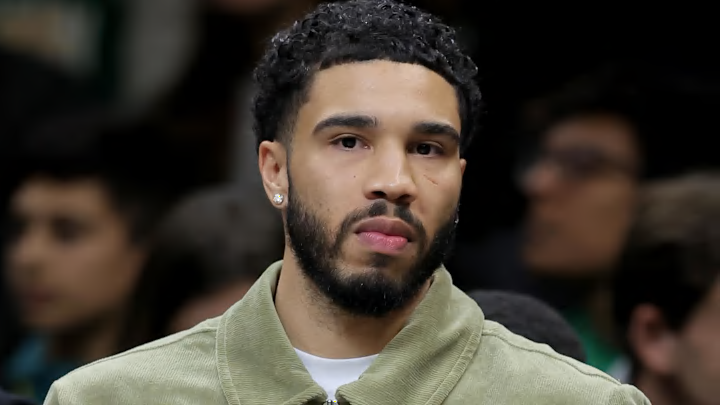
The inevitable return of Jayson Tatum further bolsters this excitement.
Even though there has not been an official announcement from the team about Tatum returning to action this season, all signs are pointing towards him suiting up soon.
The 27-year-old forward has been open about his desire to play this season, and the Celtics clearly have a lot to play for over the next few months. As good a story as it would be to see Tatum return ahead of schedule and lead the Celtics to another title, the risks associated with this decision shouldn't be overlooked.
Celtics Can't Overlook Risks in Jayson Tatum's Return
NBA insider and notable Celtics fan Bill Simmons reported that Tatum could return to action on Friday against the Dallas Mavericks (h/t @TheDunkCentral). This would give him 20 regular-season games to play himself into shape and integrate into the lineup before the playoffs.
If Tatum returns this week, he would be returning in less than ten months, significantly less time than his counterparts in recent years.
For example, Dejounte Murray of the New Orleans Pelicans just returned last week after missing 13 months of action. Kevin Durant, who suffered an Achilles injury in the 2019 NBA Finals, didn't see NBA action for 18 months before suiting up again. Obviously, every player is different, and everyone will respond differently, but Tatum is clearly taking a risk here.
More under-the-radar aspect of his return, however, relates to the Celtics on the court. Tatum raises Boston's ceiling, but could also lower its floor.
The Celtics currently have the second-best offense and seventh-worst defense in the league. There is an obvious risk in integrating a high-usage player like Tatum coming off a 10-month absence at this stage of the season.
During Tatum's recovery, in a widely circulated video, he was telling his doctor, "I ain't coming to be no role player, doc. Appreciate you."
This is the mindset Tatum has, and it has served him well throughout his career. He has built his game around and idolized Kobe Bryant, after all. However, it may not serve the Celtics well.
Celtics Must Be Cautious with Tatum Decision
If Tatum returns and embraces more of a three-and-D role for the rest of the season, he would obviously be a value add. If he has a 30+% usage, as he has had in each of the last five seasons, he may be taking more from the table than he is putting on. Taking the ball away from the more efficient Celtics to give it to Tatum to get himself into playoff shape may not be in Boston's best interests.
Moreover, players tend to be a step slower defensively when they first return from long-term injuries. They are generally more focused on finding their offensive rhythm rather than locking in on defense. Tatum has long taken pride in his defensive ability, and Celtics fans shouldn't be too concerned in the long run, but it can be a major issue this season.
Celtics fans and the organization should obviously be thrilled to see Tatum back on the court. It's just important to remember the potential downsides while fantasizing about the upside of the decision.
More Boston Celtics News & Rumors:
 Add us as a preferred source on Google