

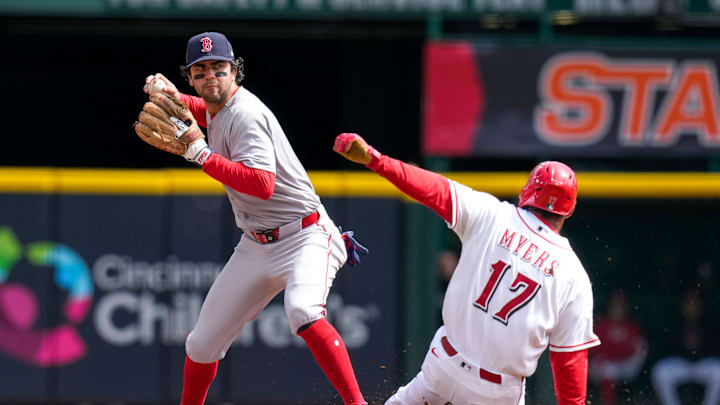
The first week of the season has not gone particularly well for the Boston Red Sox, especially after an Opening Day victory in Cincinnati. The hitters are not hitting, the pitchers are not pitching, and the fielders…actually, the fielding has been pretty solid. While one would expect the ship to right itself once it passes beyond the shallow waters of a small sample size, structural problems are present that, in turn, should open opportunities.
No one questions the outfield’s potential, but the infield was a question all winter long, and the early results have been less than reassuring. Willson Contreras is taking solid at-bats, but Trevor Story is mired in a significant slump on both sides of the ball (13 strikeouts in the first six games, plus a pair of errors). Third baseman Caleb Durbin has been nearly as bad, as he is yet to find his first hit in a Red Sox uniform, and has the lowest fielding percentage on the team (.900, or one error in ten chances).
Here, then, is a chance for Marcelo Mayer, the top prospect, to prove his worth. You know his pedigree—fourth overall selection in the 2021 draft, a brilliant talent held back only due to yearly injuries. Mayer came up last season after Alex Bregman went down with a severe quad strain and handled the cold corner well with the glove, while showing intermittent flashes with the bat.
Marcelo Mayer Too Necessary for Red Sox to Keep at 2B for Long
Though drafted and developed as a shortstop, Mayer has played but three innings at his native position at the major league level, the remaining 341 split between third (248.2) and second (92.1). Despite being initiated at these two positions at the highest level, he has served adequately and at times excellently.
As a hitter, he remains a work in progress, profiling plus-power and slightly above-average contact ability, though that will. require learning major league pitch recognition. In a nudge over 150 plate appearances, Mayer has walked ten times, but struck out nearly a third of the time. Yet, half of his hits have been for extra bases, and his minor league statistics show a trend towards improvement at each level after initial struggles.
So far, the Red Sox have seen fit to deploy Mayer at second in 2026, but given their penchant for promoting versatility, it is unlikely he will see action from this lone perspective. Story, despite a renaissance in 2025, is 33 years old and no longer capable of upholding his bat’s streakiness with deft glove work; sooner rather than later, he will be moved off of short and to second base. One is reminded of how previous franchise shortstop Xander Bogaerts originally made his impact at third before replacing the aging Stephen Drew at his natural position.
Of course, Durbin, who lacks Story’s track record of major league success, may force his own eclipse. While he did solid work for the Brewers last year, he sported only a league-average bat that depended on contact and is already 26 years old. Boston is his fourth organization, and his minor league statistics suggest little more upside to his hitting.
Here lies the rub: neither Durbin nor Story is likely to last the season in their current positions, due to aging or other means of regression. Primary infield reserves are glovemen Andruw Monasterio (career slash rates of .249/.319/.351, 86 OPS+) and Isiah Kiner-Falefa (.262/.310/.349, 82 OPS+). Behind them are unproven infielders Mikey Romero and Kristian Campbell, both with the WooSox to start the season.
By the end of the season, Mayer will be the best hitter of the current quintet. Between that and his exposure to multiple positions, the former Top 15 prospect needs only to stay healthy to have an impact beyond the mere sum of his statistics.
More Boston Red Sox News and Rumors:
 Add us as a preferred source on Google