

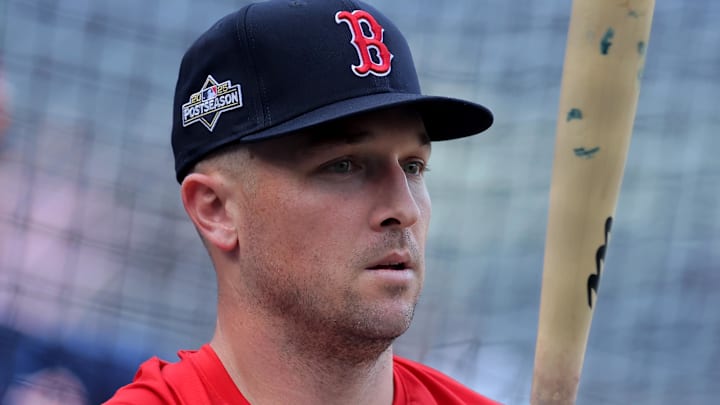
Alex Bregman is officially a Chicago Cub, agreeing to a five-year, $175 million contract that includes a full no-trade clause and no opt-outs, the kind of security that veteran third baseman was looking for going into free agency this winter.
On the surface, it's easy to view the Boston Red Sox's failure to retain him as another missed opportunity, similar to Pete Alonso leaving for the Baltimore Orioles during the Winter Meetings last month. But, a recent, yet inevitable, revelation of the further contract details on Bregman's deal with the Cubs suggests that the Red Sox may have actually dodged a bullet by leaving the table once Chicago put all their chips in.
Chicago's contract represents a significant financial commitment, perhaps more than initially seemed. According to multiple reports, about $70 million of the $175 million package is deferred, meaning the present-day cash obligations and luxury-tax implications are spread out over many years. The Red Sox were still committed to the deferred money, but it was "decades later," and they didn't want to commit to the no-trade clause.
Additionally, the money was significantly lower than the Cubs' offer, allegedly around the rumored $160 million, according to the New York Post's Jon Heyman on Sunday morning.
That kind of structure on Bregman's new deal benefits the signing team's books and payroll flexibility, but it also ties them to a rather large overall guarantee long after the player's peak production window.
Alex Bregman's Departure Gives Red Sox Financial Flexibility
For a team like the Red Sox, which has actively avoided long-term megadeals in recent years, that's exactly the type of commitment that threatens future flexibility. Boston's front office has repeatedly emphasized fiscal discipline and a reluctance to sign players into their mid-to-late 30s, especially at the high annual costs that could hamper midseason maneuverability or future free agency windows.
Although the Red Sox were willing to go to five years, they also offered him $165 million as their confirmed final offer, all guaranteed money with "significant deferrals," according to MassLive's Sean McAdam (h/t @tylermilliken_). It was a deal that would be only $2 million less per season than the Cubs. But the no-trade clause was the dealbreaker.
Significantly, Boston's prior deal with Bregman last offseason was three years, worth $120 million with opt-outs after each of his first two seasons, along with some deferrals that lowered the present-day financial impact. That type of structure aligned with Boston's approach: front-loaded, flexible, and not locking the club into a long-term deal. Most importantly, the biggest emphasis is on that last note.
In contrast, Chicago's core, which is built around so many homegrown talents after selling off their 2016 World Series core back in 2021, also just made the playoffs and made it to Game 5 of the National League Division Series before getting eliminated by the Milwaukee Brewers. This offseason, for them, was a time to add.
From Boston's perspective, not matching that level of commitment may keep them out of future years where Bregman's performance could regress, while his salary still counts heavily against the books.
So, while fans will understandably lament losing a productive All-Star bat like Bregman, the terms he accepted from Chicago may ultimately validate Boston's caution. In a league where long, expensive contracts often age poorly, Boston's avoidance of a massive commitment, even in losing the player, might prove to be a smart long-term decision. Just like Xander Bogaerts before him and Anthony Rendon before him, Bregman may lose production in the next couple of seasons. Whether that's injury or offensive decline, it's inevitable.
With Kristian Campbell, Marcelo Mayer, and even Romy Gonzalez on their roster, the Red Sox will be okay. It's a valid reaction to be frustrated, but be excited for Mayer's second season and Campbell's possible bounce-back season. Bregman's gone, and there's no way to change it. It's time to move into the future, and the future is now.
More Boston Red Sox News & Rumors:
 Add us as a preferred source on Google