

At the end of Moby Dick, Captain Ahab catches up with his bane, the titular white whale. After a contest of three days, heedless of warning, Ahab finally corners the beast and sets off in a small boat from the Pequot to meet his foe. Though successful in striking Moby Dick with a harpoon, the angered leviathan wreaks his own vengeance by destroying the Pequot.
Ahab, immersed in the madness of his quest, attempts to quickly finish his nemesis, only for the cord of the harpoon to tangle itself around his neck. Moby Dick dives back into the deep, bringing Ahab along with him to a watery grave.
The Boston Red Sox had their own whaling trip last winter, and that catch ultimately cost them the foundation of their lineup. For one year of Alex Bregman, the team alienated and subsequently traded away their incumbent third baseman and best hitter in Rafael Devers; without either player, third base has turned from the infield’s strongest point to an open-ended question with no appealing answers.
Devers, whatever his failings in defensive aptitude, had been Boston’s best hitter since 2019. He was also in the early stages of a 10-year deal that would pay him $313.5 million through 2033; even if his shift from third to first or designated hitter was an eventual inevitability, that move could be delayed several more years.
Had Bregman been secured long-term, this loss of Devers could be at least mitigated. Instead, the Red Sox are afflicted with a nightmare of their own making: at least two infield spots lack plausible candidates to fulfill, and the longer-term picture is even more bleak.
Alex Bregman's Departure Puts Red Sox's Infield in a Bind
Most obviously, third base requires a solid answer. Top prospect Marcelo Mayer came up as a shortstop but filled in admirably at the hot corner while Bregman missed two months last summer. The issue with Mayer lies not in his talent, but in his lack of durability—each professional season has ended with him on the injured list. Unless and until he completes a season, the Red Sox ought not to see him as more than a part-time player.
Of course, playing Mayer at third means Trevor Story will continue at shortstop. While Story seemingly answered his own questions about health with a bounce back in 2025, he is also entering his age-33 season and an increasing defensive liability at the most important position for defensive glovework. Ideally, the veteran would move to second to accommodate both his skillset and the emerging Mayer.
Speaking of which, second base has been a black hole for nearly a decade now. Kristian Campbell took the plurality of playing time and still has a future in Boston, but defense has never been his calling card. He has played everywhere but catcher as a professional and seems best fitted for either first base or left field.
After Campbell found his way back to Worcester, the keystone position fluctuated between Romy Gonzlaez and David Hamilton. The first is a platoon infielder who had 0.2 career WAR entering 2025; his .378 BABIP, 90 points above the league average, made him a pleasant surprise, but no one should expect more than a regression to his previous standard in 2026.
Hamilton is a good fielder and excellent baserunner with a career on-base percentage of .283, with a mark of .257 last season. He was used, rightfully, as a defensive replacement and pinch runner for the most part.
This is the current layout of talent entering 2026. Any prognostications for 2027 and beyond feature even less excitement. Story is under contract for 2027 with a $25 million team option for 2028, which the Red Sox will surely decline. Unless some prospect comes up fast, the only player in the organization that could plausibly fulfill any of these three spots is Mayer.
Red Sox Have Outside Options, Too
Several players have been bandied about in trade discussions, though at the time of writing, no such deal has come to fruition. Isaac Paredes is a two-time All-Star third baseman, currently with the Houston Astros, and will not reach free agency for another two seasons. St. Louis Cardinals utility man Brendan Donovan has also come up in connection with the Red Sox, but he is already 29, left-handed, and only two years from free agency.
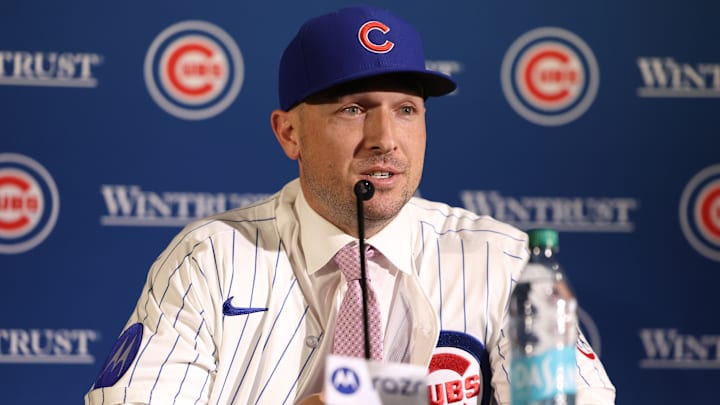
Nico Hoerner has held down second for the Chicago Cubs, combining contact hitting and Gold Glove defense work, but he would act as a single-year rental. His teammate, Matt Shaw, retains six seasons of team control, plays an excellent third base, and was a league-average hitter as a rookie with promise of further development. Shaw, of course, lost his incumbency when the Cubs signed Bregman last week.
The best remaining third baseman on the free market, Eugenio Suarez, has neither age (35 in July) nor recent work to provide sufficient replacement. His bat has always covered for shoddy glovework, but even that has shown signs of degradation. His walk rate has fallen below league average for the first time in his career these last two seasons, while whiffing as frequently as ever (28.7%).
Such are the consequences of an ostensibly successful hunt. The cost of four months of Alex Bregman will haunt the Red Sox through the end of the decade.
More Boston Red Sox News & Rumors:
 Add us as a preferred source on Google